


Everyone Reviews Checkout Abandonment. Few Review Coupon Abandonment.
One of the frustrating things about BFCM reporting is that teams can usually tell where revenue was lost, but not always why it was lost.
Checkout abandonment is a good example.
Most retailers know their abandonment rate. Many can identify which channels drove traffic, which campaigns generated revenue, and which promotions performed best.
Far fewer can answer a simpler question:
How many shoppers abandoned after encountering a problem at the promo code field?
Most reporting tools don’t make it easy to see.
When a shopper uses an expired code, an ineligible offer, or sees a competitor’s offer and leaves, that session ends up in the same abandonment bucket as someone who got distracted, or changed their mind. The abandonment gets recorded. The reason behind it usually doesn’t.
That creates a meaningful blind spot.
Abandonment reaches 73–78% on Black Friday and exceeds 80% on Cyber Monday (Content Square). At that volume, even relatively small sources of friction can translate into meaningful revenue loss.
Why Coupon Friction Gets Worse During BFCM
Promotions become significantly more complex during peak season.
A brand might be running email-exclusive offers, SMS promotions, affiliate campaigns, influencer partnerships, paid social discounts, loyalty incentives, and product-specific offers all at the same time.
From an internal perspective, those campaigns may be organized and clearly documented. From a shopper’s perspective, things are often less clear.
They may have received a code through an email campaign, seen one on social media, found another on a coupon site, or had a browser extension surface multiple offers at checkout.
In many cases, shoppers aren’t evaluating where a code came from or who it was intended for. They’re simply trying to find the best available discount.
When a discount doesn’t work as expected, shoppers aren’t thinking about attribution rules, cart exclusions, campaign dates, or eligibility requirements. They’re thinking:
Why isn’t this discount working?
Some shoppers keep trying additional codes. Others abandon the purchase altogether.
In standard analytics, both behaviors are often absorbed into broader checkout metrics, making it difficult to understand how much friction originated at the coupon field.
Where Coupon Friction Usually Comes From
Shopper-Driven Friction
Some coupon failures originate from shopper behavior rather than broken promotions.
The code may be valid, but the shopper:
- Doesn’t meet the promotion requirements
- Enters the code incorrectly
- Uses an offer intended for a different audience or channel
- Attempts a code found through a coupon search that no longer applies
These situations are common during BFCM because shoppers are actively searching for discounts and often encounter multiple offers across different channels.
One misconception we frequently see is that expired codes are the primary cause of coupon-related abandonment.
In reality, eligibility issues are often just as common. Shoppers are using the right code on the wrong cart.
A shopper who is $10 short of a minimum-spend requirement experiences the same frustration as someone using an expired promotion.
From the shopper’s perspective, the distinction doesn’t matter. They entered a code expecting a discount and didn’t receive one.
For brands, these interactions often appear as standard checkout abandonment unless coupon activity is being tracked separately.
Third-Party Extension Interference
Other forms of coupon friction originate outside the promotion itself.
Codes frequently spread beyond their intended audience through coupon sites, forums, and browser extensions, creating checkout experiences that brands may not even realize are occurring.
Browser extensions are often the most challenging example.
A shopper arrives through a paid campaign, reaches checkout, and an extension begins testing offers automatically. The result can vary:
- A conflicting code changes the cart total unexpectedly
- An expired code generates an error message
- A competing offer surfaces during checkout
- An affiliate code is applied to a session driven by paid media
From a reporting perspective, these outcomes rarely appear as extension-related events. They typically surface as checkout abandonment, attribution discrepancies, or unexplained conversion loss.
How Brands Fix Coupon Code Abandonment: A Three-Step Approach
First, They Figure Out What’s Actually Happening
Before brands can reduce coupon-related abandonment, they need to understand where the friction is coming from.
Some discover shoppers repeatedly failing eligibility requirements. Others find expired influencer codes still circulating months after a campaign ends. Some uncover extension activity they didn’t realize was occurring at checkout.
The common thread is visibility.
Without it, teams end up optimizing checkout abandonment broadly instead of addressing the specific interactions causing it.
This is where tools like Coupon Analytics can help by surfacing promo-code interactions, failure patterns, and abandonment behaviors that standard funnel reports often miss.
Second, They Create Recovery Paths
One thing that becomes clear when reviewing checkout sessions is that not every failed code attempt represents a lost customer.
Many shoppers still intend to purchase. They simply hit friction at the wrong moment.
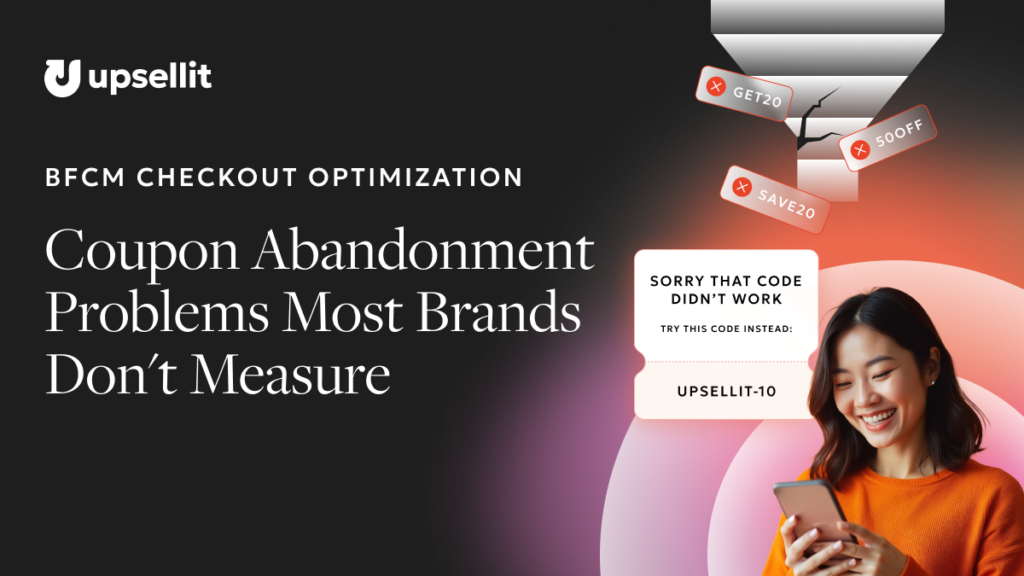
Coupon Corrector addresses those situations by replacing dead-end error messages with a more useful next step.
- A typo is corrected silently
- An expired or invalid code triggers a pre-approved alternative offer
- A cart that doesn’t meet a threshold condition surfaces products to help the shopper qualify, or adjusts the offer to match current cart contents
- A misattributed channel code is resolved automatically, correcting attribution
Across deployments, Coupon Corrector reduces checkout abandonment by up to 25%, with 10-30% of shoppers who would otherwise have abandoned accepting the alternative and completing their purchase.
At BFCM traffic volume, that recovery rate represents material revenue that no standard post-mortem would have identified as recoverable.
For a full breakdown of how Coupon Corrector works across each failure scenario, see our blog how correcting failed codes reduce checkout abandonment.
Third, They Address Extension-Driven Friction
Extension-related issues are often the hardest to diagnose because they happen outside the checkout experience most brands think they’re managing.
A shopper arrives through a paid campaign, reaches checkout, and a browser extension starts working in the background testing alternative codes, surfacing competitor offers, or applying affiliate attribution to a session the brand already paid to acquire. The shopper experiences something different from what the brand intended. Neither of them knows it.
Ad Extension Manager gives brands visibility into that activity and control over how extensions interact with the checkout environment so what happens inside checkout matches what the brand designed.
One thing that stands out across all of these examples is how rarely the issue was obvious beforehand.
None of these brands were actively tracking coupon-related abandonment when the problem surfaced. In every case, the friction was happening already, it just wasn’t being measured.
How Different Brands Encounter and Resolve Coupon Friction
The three tools above address distinct problems, but in practice they often work together.
A brand identifies an issue through Coupon Analytics, resolves it with Coupon Corrector, and protects the environment with Ad Extension Manager.
Here is how brands across different industries have put each solution to work.
Home Goods: Influencer codes leaking beyond the intended audience.
While running an influencer campaign, a home goods brand noticed coupon redemptions far exceeding projections. Most of the shoppers using the code had not come from social media at all.
Browser extensions were scraping the influencer code and automatically applying it to unrelated sessions, inflating commission payouts and misattributing sales to the social campaign.
After implementing Ad Extension Manager, the brand relaunched with new codes and immediately saw redemption align with actual traffic source.
Misattributed sales stopped. Among shoppers whose extensions were blocked, the conversion rate reached 38%.
Fashion & Apparel: Shoppers abandoning just short of the spend threshold.
A fashion brand running a minimum-spend promotion was losing shoppers who attempted the discount code with carts that fell just short of the requirement.
Rather than returning a dead-end error, Coupon Corrector identified shoppers within 10% of the threshold and gave them two paths: product recommendations to unlock the original 25% discount, or a smaller 15% discount on their current order.
The result was a 50% click rate on the engagement and a 27% conversion rate among shoppers who would otherwise have abandoned.
Footwear: Generic code attempts driving checkout drop-off.
A footwear brand carrying discounted and overstocked styles attracted deal-seeking shoppers who regularly attempted generic codes like “WELCOME10” or “BLACKFRIDAY” without having received a specific offer.
After three consecutive failed attempts, Coupon Corrector automatically presented a 10% discount code instead of a fourth error message.
Click rate on that engagement reached 61%, with a 44% conversion rate among the recovered segment.
Electronics: No visibility into which promotions were actually working.
A major electronics retailer running rotating promotions across multiple product categories had no reliable way to track which codes were working, which were failing, and why.
Coupon Analytics gave them a complete breakdown of code usage and failure patterns by category, revealing that certain product lines consistently outperformed others in redemption.
That visibility allowed the brand to reallocate promotional resources based on actual performance rather than assumption.
Haircare: Expired influencer codes still driving abandonment.
After reducing its influencer program by approximately 50%, a haircare brand wanted to understand how many shoppers were still attempting old influencer codes and what that was costing in abandonment.
Coupon Analytics surfaced a significant spike in failed code attempts following the pause. Because restarting the campaigns wasn’t feasible, the brand implemented Coupon Corrector to offer a modest alternative to shoppers attempting expired influencer codes, converting a previously invisible abandonment driver into a recoverable segment.
To see these scenarios in more detail, read Upsellit’s Coupon Experience Case Study.
It explores a range of coupon-related checkout scenarios and the strategies retailers have used to improve visibility, reduce abandonment, and create a smoother promotional experience.
Before Peak Season Arrives
Most teams don’t start investigating coupon-related abandonment until after BFCM is over.
By that point, promotion rules, channel strategies, and campaign calendars are already locked in.
The brands that perform best upfront have already worked out:
- Which codes are active and who should be using them
- What happens when a code fails
- How those failures are measured
- Whether third-party extensions are influencing the experience
If coupon-related abandonment has never been separated from your broader checkout metrics, there’s a good chance you’re treating multiple problems as one.
A detailed review of your ecommerce site can surface those gaps before peak season traffic arrives.
Get ready for BFCM with a detailed review of your ecommerce site and a roadmap to fix revenue gaps before peak season.


Not ready for an audit yet? Start with the BFCM 90-Day Preparation Plan to build your foundation before peak season.