

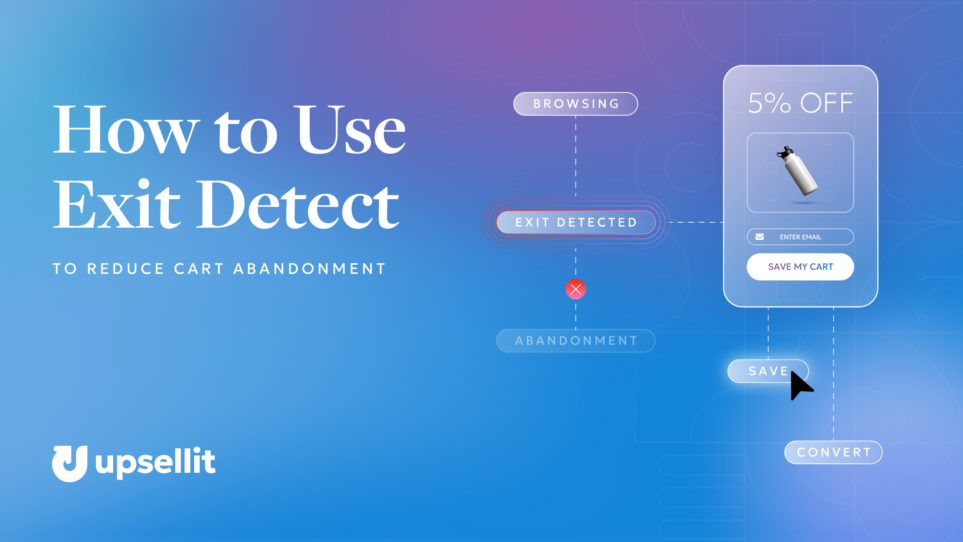
Timing plays a critical role in reducing cart abandonment. Engage too early, and you risk interrupting the shopping experience. Engage too late, and the shopper is already gone.
Exit detection technology identifies when a shopper is about to leave a website and triggers targeted messaging at that exact moment to prevent shoppers from leaving. This allows brands to engage high-intent shoppers without disrupting the natural browsing experience.
With ecommerce brands losing $18 billion in revenue each year due to cart abandonment, engaging shoppers at the right moment is critical. Brands can’t afford to rely on guesswork or static timing rules.
Upsellit’s Exit Detect technology helps recover lost conversions and drive more completed purchases by delivering the right message to the right shopper at precisely the right time.
Because Exit Detect is designed to address abandonment behavior, it helps to understand the broader factors that cause shoppers to leave. For a deeper look at abandonment trends, causes, and recovery strategies, explore Upsellit’s complete guide to cart and checkout abandonment.
What Is Exit Detect Technology?
Upsellit’s Exit Detect technology is a behavioral targeting tool that identifies when a website visitor is about to leave and triggers a targeted message or experience to prevent abandonment. It uses real-time behavioral signals to determine exit intent and engage shoppers at the most critical moment in the purchase journey.
In simple terms, Exit Detect gives brands one last opportunity to present relevant information, offers, or next steps before a shopper leaves the site. This helps reduce cart abandonment, recover revenue, and capture leads without interrupting the browsing experience too early.
How it Works
Exit detection technology monitors on-site behavior to distinguish between normal browsing and true abandonment intent. By analyzing patterns such as mouse movement, navigation behavior, and engagement signals, it predicts the exact moment a shopper is about to leave.
Upsellit’s Exit Detect technology combines advanced, customizable segmentation with real-time behavioral detection, allowing brands to target shoppers based on factors like cart contents, browsing history, or past interactions. This enables highly personalized messaging at the exact moment of abandonment.
A simple way to think about this is to picture a shopper in a physical store. They browse the aisles, explore different products, and add items to their cart. Then, instead of heading to checkout, they begin moving toward the exit without completing their purchase.
As the shopper approaches the exit, a store associate might remind them of a storewide sale that’s ending soon. This intervention could provide just enough incentive to turn around and complete their purchase.
Exit Detect brings that same real-time intervention into the online shopping experience, delivering the right message to the right shopper at exactly the right time.
Benefits of Exit Detect Technology
Exit Detect helps brands recover otherwise lost revenue by engaging shoppers at the exact moment they are about to leave. Because these interactions are triggered by real-time behavior, they focus on shoppers who have already demonstrated meaningful purchase intent.
Shoppers express interest in different ways throughout the purchase journey, from casual browsing to deeper exploration into product details like size, color, or features.
Shoppers who add items to their cart show stronger purchase intent than casual browsers, making them a key audience for abandonment recovery strategies. Exit Detect allows brands to act on that intent before it’s gone.
Key benefits of exit detection technology include:
- Reduced cart abandonment: Re-engage shoppers before they leave without completing their purchase.
- Increased conversion rates: Deliver timely, relevant messaging that encourages shoppers to take action.
- Higher average order value (AOV): Introduce incentives or recommendations that increase purchase size.
- Lead capture and remarketing opportunities: Collect email or SMS opt-ins from shoppers who aren’t ready to purchase yet.
- Improved shopper experience: Engage shoppers at the right moment without disrupting the journey too early.
By triggering campaigns based on real-time abandonment intent, brands can apply a wide range of cart recovery strategies to turn missed opportunities into increased revenue.
Mobile Exit Detection
Mobile browsing behavior differs significantly from desktop, which means traditional abandonment detection methods don’t always apply. On desktop, exit intent is often identified through cursor movement, such as when a user moves their mouse toward the browser bar or closes a tab. On mobile devices, these signals don’t exist.
Instead, mobile exit detection technology relies on behavioral patterns like scroll speed, tap activity, and navigation behavior to determine when a shopper is about to leave. This allows brands to identify abandonment intent without relying on mouse-based interactions.
Mobile traffic now makes up a significant portion of ecommerce activity, with mobile sales expected to reach $856 billion in the U.S. by 2027. As mobile traffic keeps growing, brands need a mobile-specific approach to stop abandoning shoppers from going undetected.
Upsellit’s patented Mobile Exit Detect identifies the differences between normal mobile browsing, such as scrolling or navigating between pages, and true abandonment behavior. This ensures that campaigns are only triggered when a shopper is genuinely about to leave, rather than interrupting the experience unnecessarily.
Best Practices for Implementing Exit Detect Technology
Personalization and Targeting
Effective exit intent campaigns rely on reaching the right shoppers with the right message. Not every shopper should see the same experience, especially at the point of abandonment.
Brands should use behavioral and session data, such as cart contents or browsing history to tailor campaigns to each shopper. For example, a brand running a sale on their womenswear can target shoppers who have already shown interest in that category to ensure the message is both timely and relevant.
Messaging and Design
Exit intent campaigns need to capture attention while clearly communicating value. Because these interactions happen at a moment when decisions are made quickly, messaging should be concise, relevant, and easy to understand.
Campaigns should also maintain a consistent, on-brand design to build trust and feel connected to the user experience. Well-executed messaging and design grab the attention of an abandoning shopper and keep it long enough for them to see the value of the offer.
Mobile Optimization
Mobile abandonment campaigns require a different approach because of the differences in user behavior and screen size.
To optimize for mobile:
- Limit form fields to avoid data-entry fatigue.
- Use large, thumb-friendly CTA buttons to improve usability.
- Ensure designs are responsive, fast-loading, and easy to navigate.
These adjustments help ensure that abandonment campaigns are easy to engage with on smaller screens, where usability and speed directly impact performance.
Abandonment-Intent Technology Examples and Use Cases
Highly successful exit intent campaigns will come in many different forms. From retargeting campaigns and cart recovery emails to lead generation and checkout page campaigns, there are endless opportunities to leverage Upsellit’s Exit Detect technology.
Here are several common use cases that drive results:
- Incentivize purchases: Present limited-time discounts or free shipping offers to encourage immediate conversion.
- Capture leads: Prompt shoppers to provide an email address or phone number to continue the conversation later.
- Save carts for later: Give shoppers the option to easily return and complete their purchase at a more convenient time.
- Recommend products: Suggest alternative or complementary items based on browsing behavior or cart contents.
- Create urgency: Highlight limited-time promotions or low inventory to motivate faster decision-making.
These strategies can be tailored to specific audiences and triggered at the moment a shopper is about to leave, making them highly effective when implemented correctly.
Real-World Examples of Exit Detect Campaigns
Category-Specific Promotion
A popular memorabilia retailer wanted to clear out inventory from a specific product category. To help, Upsellit designed a campaign targeting shoppers who had viewed products in that category within the last 180 days. At the moment of abandonment, those shoppers were presented with a promotion specific to that category to re-engage their interest and encourage them to complete a purchase.
Free Shipping Incentive
A floral delivery retailer partnered with Upsellit to implement a free shipping offer for abandoning shoppers who met specific criteria, including location eligibility and having a bouquet in their cart. Because free shipping is a strong motivator, this well-timed incentive helped convert shoppers who were already close to making a purchase.
Gamified Free Shipping Threshold
An environmentally conscious skincare brand faced high levels of cart abandonment from shoppers who had not yet reached the minimum order value to qualify for free shipping. To address this, Upsellit designed a gamified experience that calculated how close each shopper was to qualifying. By making the goal feel more achievable, the campaign encouraged shoppers to increase their cart value and complete their purchase.
How to Measure the Success of Your Exit Detection Campaign
Measuring the success of an exit detection campaign starts with tracking the right performance metrics. Because these campaigns are designed to reduce abandonment and recover conversions, success should be evaluated based on both engagement and revenue impact.
Here are key metrics to monitor:
- Abandonment rate: The percentage of shoppers who leave the site without completing a purchase.
- Conversion rate: The percentage of shoppers who complete a desired action after interacting with a campaign.
- Average order value (AOV): The average amount spent per transaction.
- New-to-file lead generation: The number of new email or SMS opt-ins captured from abandoning visitors.
- Return visitors: The number of shoppers who come back to the site after initially leaving.
Tracking these metrics over time provides a clearer picture of how exit intent campaigns influence shopper behavior and overall performance.
To fully understand results, campaigns should be given enough time to collect meaningful data before making adjustments. Once you’ve collected sufficient data, the next step is to interpret and utilize it for ongoing optimizations to help improve performance and maximize revenue recovery.
Upsellit’s reporting dashboard and team of experts make it easy to view, track, and interpret every metric involved in your campaign.
Why Upsellit’s Exit Detect Technology Works
When it comes to reducing cart abandonment, success comes down to timing and execution. Engaging shoppers too early can disrupt the experience, while engaging too late can result in a lost sale. Upsellit’s Exit Detect technology solves this challenge by identifying the right moment to act.
Exit Detect is designed to distinguish between normal browsing behavior and true abandonment intent, ensuring that campaigns are triggered at precisely the right time. Combined with advanced segmentation and personalization, this allows brands to deliver relevant messaging that aligns with each shopper’s behavior and stage in the journey.
Rather than relying on static rules or manual execution, Upsellit provides a fully managed approach to campaign strategy, implementation, and optimization. From initial setup to ongoing performance analysis, campaigns are continuously refined to improve results over time.
As cart abandonment continues to impact ecommerce performance, you need a better way to engage shoppers before they leave. Upsellit helps ensure those moments aren’t missed and turns potential revenue loss into increased conversions. Watch our brief Exit Detect explainer to see first-hand how Upsellit helps recover lost revenue.